Saturday, January 16, 2010

Part III of III: CARTIER and AMERICA, San Francisco

Part III of III


_____________________________________________________


Featuring an 143 carat emerald, this platinum, emerald and diamond necklace was owned by Lady Granard (nee Beatrice Mills) a descendant of the founders of the town of Millbrae.
Cartier London 1932.



_____________________________________________________


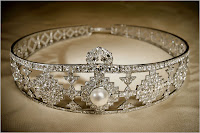
Photos: Tobacco heiress Doris Duke, left photo, wore this platinum, diamond and pearl bandeau, at her "coming out" party, which she inherited from her mother. Cartier Paris 1924.

Note to readers: "Coming out" had a different meaning back in those days, as in debutante. For more on the subject go to http://en.wikipedia.org/wiki/debutante

Doris Duke was the only child of James Biddle Duke, founder of the American Tobacco Company (and benefactor of Duke University). Upon her birth the press named her the "Million Dollar Baby."

According to legend, her father on his deathbed said to his daughter: "Trust no one. They all want your money."

Ms. Duke liked to say: You can't buy a person. But you sure can rent one for a while."

She once worked for $1.00 per week in the war relief effort, donating the balance of her salary to charity. I've discovered," she said, at the time, "That it's fun to work, I guess."
But mostly she indulged in philanthropy. According to the Doris Duke Charitable Foundation, Ms. Duke gave away $400 million during her.


Photos

Left: Doris Duke in 1978 at the storied Studio 54 in New York with Steve Rubel (co-founder of Studio 54 with current hip hotelier Ian Schrager), and dancer and choreographer Martha Graham on the right (founder of the Martha Graham Dance Company, the oldest and most celebrated modern dance company in the world).

Center: Crowds throng 54th Street (between 7th and 8th Avenue) outside Studio 54 in its hey day, with 'wanna-be' patrons jockeying for position and a chance at a highly coveted 'admittance nod' (i.e. "your in") from the door keepers. My sister and I made it in once, and now 32 years later my daughter lives next door in a new high rise building. Small world!

Right: Doris Duke with Imelda Marcos her close friend, and neighbor to her famed home Shangra La in Hawaii.


In 1988, The New York Times reported that Doris Duke posted the $5 million bail of the former Philippines first lady, Imelda Marcos, who was charged along with looting her country. A lawyer for Ms. Duke, was quoted as saying that his client had been "happy to help a friend."


Miss Dukes gesture of friendship followed the loan of her personal Boeing 737 to fly Mrs. Marcos and her entourage from Hawaii to New York.


Photo
This is an image of a Boeing 737 jet, the type owned by Doris Duke as her private aircraft, from the Boeing website. The caption for this image says, "seats 112-132 passengers."

Nice flight...if you can get it.

Mrs. Marcos was described as being "grateful and tearful" at Ms Dukes gestures.

How sweet! Oh pulleeze


________________________________________________

Ms. Duke collected treasures, homes pets, even including two camels and a pet leopard. She died at 80 in 1993, at her home, Falcon's Lair in Beverly Hills, once the home of Rudolph Valentino, leaving an estate worth an estimated $1.3 billion.


Photo: Falcon's Lair built by actor Rudolph Valentino

In the end, she made her butler, the executor of her massive estate. He got $5 million in fees plus $500,000 a year. Other beneficiaries were Ms. Duke's camels, which were kept for life, and her dog, which got $100,000 a year.


Photos: Two of the many beneficiaries of Doris Duke's vast estate

Left: Bernard Lafferty, the Butler, $5 million, plus $500,00 per year

Right: Her two camels


____________________________________________________


Doris Dukes legendary Islamic inspired home, Shangra La (photos below) is possible to tour. Contact the Honolulu Academy of Arts (http://www.honoluluacademy.org/)


Photos: Shangra La, Dukes home on the island of Oahu.
Left: The Dining Room
Center: The Baby Turkish Room, purchased from a Syrian palace required the demolition of a room of the house in order to accommodate its size. Duke installed Persian silk carpets, ceramics and textiles from the Ottoman Empire (particularly from the 14-15th century).
Right: Dukes private bath inspired by her visit to the Taj Mahal, with inlaid marble walls and floors, designed and made for her in India.


______________________________________________________


Photo: The Playhouse at Shangra La, quite possibly the most coveted of invitations by friends of Ms. Duke.


____________________________________________________


Here is a tidbit that is quite possibly more interesting to me than my readers, but I'll give it a try: As I researched the jewels on display at the exhibition and the history of those that once possessed them, I learned about a rare necklace owned by Doris Duke, that she purchased from Madame Ganna Walska (as in Lotusland fame--see Part II of III)

The Doris Duke/Ganna Walska Indian Arya Necklace


The Doris Duke/Ganna Walska Arya Necklace has great historical significance not only because it was designed and created in the 19th century, but also because it came to be owned by two of the most prominent and illustrious ladies in history, Madame Ganna Walska, the renowned Polish soprano and Doris Duke, the American tobacco heiress, philanthropist and art collector.


The Indian Arya Necklace is an extremely complex example of the goldsmith's art, made up of diamonds, emeralds, sapphires, rubies and seed pearls set in gold "kundan settings", the method perfected for setting stones during the Mughal empire prior to adopting the "claw" settings from the west.


Photos
Left: Portrait of the Mughal Emperor Shah Jahan
Center: The Taj Mahal in Agra, was built by the Mughal emperor Shah Jahan in honor of his late wife, Mumtaz Mahal
Right: Portrait of Mumtaz Mahl, wife of Mughal Emperor Shah Jahan


The elaborate "Arya" necklace is made in two halves, a narrower upper half which fits around the neck, and a wider lower half which rests on the upper part of the shoulders and chest.
The necklace, was a part of the exquisite jewelry collection of Madame Walska, who was a nature lover and garden designer. Walska sold part of her jewelry collection in order to finance one more shipment of plants which included the worlds most rare Cycad plant for her final creation, the "Cycad Garden" at her 37-acre estate, Lotusland, at Montectio (Santa Barbara), CA. She bequeathed her personal gardens and her fortune at the time of her death to the "Ganna Lotusland Foundation."


Photos, above: The worlds most famous Cycad Garden, at Lotusland, for which the benefactor, Madame Walska, sold her jewels to complete.


Thus the name if the necklace quite appropriately reflects the names of the two previous owners of the necklace.

I seem to get to know the Madame better on almost a daily basis.


__________________________________________________


Okay, I've had enough, and written enough for Part III, but I'm not finished! I'll have to right an epilogue to this series in order to get in the jewels owned by Duchess of Windsor, Princess Grace, and someone I knew nothing about, but whose jewelry was the most outrageous jewelry on display, the Mexican actress Maria Felix (see the snake pic, below!).


Now you believe me?


_________________________________________________


Good night moon


Wednesday, January 13, 2010

PART ll OF lll: CARTIER and AMERICA Show, San Francisco

Part II of III


In Part I of this series, I made mention of the stories that accompanied the jewels as being almost as interesting as the jewels themselves, so I've included a few of them in this posting.

The exhibition opens with one of the famous Cartier Mystery Clocks--it is said that the clocks are to Cartier what the Easter Eggs are to Faberge. The mystery clocks are so-called because the clock is clear and transparent and one can see the hands which seem to float in solid crystal, but one cannot see the clock movement that make the hands move.
The secret? Well you'll have to read all the way to the end of Part III of III, where I will reveal what makes it tick!

Photo above:
Large Portique Mystery Clock, Cartier Paris 1923

Platinum, gold, rock crystal dial, columns and Billiken figure (the Billiken is the "God of Things As They Ought To Be"), rose-cut diamonds, coral cabochons, onyx, black enamel, gold plate, 13 jewel Breguet movement. In this clock, the Billiken figure is removable to provide access for winding the movement and setting hands. This clock was the first in a series of 6 in the form of a Shinto "shrine gate" (portique), all different and all made by Cartier between 1923 and 1925.


PHOTOS Above
Left: Ganna Walska, the young Polish beauty.
Right: Madame Ganna Walska in the courtyard of her private quarters, The Pavilion at Lotusland, with her beloved Cockatoo, Happy.
This clock was of particular interest to us, and will be to our fellow Santa Barbara residents because it was owned by the former Montecito resident, the late Ganna Walska, who bequeathed her beloved Lotusland Estate to a foundation so that we might all enjoy it in perpetuity.


PHOTOS
Top Row: Left, Lotusland, the main house; Right, The Lotus Pond with the Bathhouse beyond.
Bottom Row: Left, The entrance portal to Lotusland; Right, Madame Walska's private chambers, as completed by Cabana Home and Santa Barbara based designers Steve & Caroline Thompson.

Many of the Cartier jewels owned by Madame Walska were sold in order to purchase the worlds most rare plants and to create the foundation for Lotusland.

Our particular interest lies not only in the rich history of this estate and its former owner, but also because Caroline and I were asked to re-furnish Madame Walska's personal villa at Lotusland, The Pavilion, for last summers fundraiser. Through our research on the project, we began to feel a sort of kinship to Madame Walska as we came to know something about her taste and interests, so the surprise of seeing her name associated with this clock sent a chill up my spine. We felt like we got to know an old friend even better.

There were several pieces in the exhibition that had belonged to Madame Walska, and of particular note was this Chimera Bangle, an Indian/Chinese inspired bracelet that features a pair of colorful carved coral dragon heads, with emerald, sapphire and diamonds highlighted by green, blue and black enamel decoration.

More about the Madame: According to many sources, Madame Walska was a marginally talented opera singer whose genuine gift was marrying well and often (six times). When researching Madame, I found an interesting reference to her influence on the book, CITIZEN KANE (1941). According to Orson Welles, "the patented recipe for creating the character, Charles Foster Kane, included these ingredients:
"10 ounces of Chicago newspaper czar Harold McCormick (of the Chicago Tribune family), who left his wife, Edith Rockefeller McCormick, after being seduced by a Polish prima donna named Ganna Walska."

McCormick was the chief sponsor of the Chicago Opera Company and used his influence to have Walska cast in the opera Zaza. Frances Alda, one of the most expensive voice coaches in the world, was hired to make a singer out of Walska, a task that was in vain because Walska had an awful voice, and Zaza went down as one of the bigger disasters of 1920. Eventually, Walska walked out on McCormick, but he chased her to Europe where she convinced him that the only way to cure his impotence problem was to have thyroid glands from monkey's transpalnted into his own body by a European quack. Apparently Welles was fascinated with this story in his youth.

Viagra would have been easier (and I suspect cheaper).
________________________________________________________


Photo
Actress Gloria Swanson
In the next room we edged our way (yes, the rooms are small and they are crowded with jewels as well as visitors) closer towards a sparkling pair of rock crystal and diamond bracelets, Cartier Paris 1930, owned by the legendary actress Gloria Swanson.


Photos above:
Left: "Closeup" of the rock crystal and diamond bracelet, one of a pair owned by and worn by Ms. Swanson in the film, Sunset Boulevard.
Right: Gloria Swanson, waiting for "her closeup" (Mr. DeMille), as the fading film star Norma Desmond, shown wearing the rock crystal and diamond bracelets in a publicity photo for the film, Sunset Boulevard.
________________________________________________________


This silver, onyx and nephrite eight-day clock, circa 1943, with one central and four smaller time zone's (estimated to be worth $600 thousand - $1 million), was given as a personal gift by Pierre Cartier to President Franklin Delano Roosevelt.

______________________________________________________


Photos
Left: "The poor little rich girl", Barbara Hutton
Center: The flexible Tiger brooch, part of a suite including ear clips, Cartier Paris 1957.
Right: Barbara Hutton and movie star Cary Grant on their wedding day.
Undoubtedly, the stories surrounding the Woolworth heiress Barbara Hutton were the saddest. She, the granddaughter of F.W. Woolworth and niece of E.F. Hutton, was the heir of the $40 million (estimates go as high as $150 million) Woolworth fortune.

At her debutante ball, guests were entertained by the stars Rudy Vallee and Maurice Chevalier.

She was married seven times: Five members of royalty, one Diplomat, and one movie star (Cary Grant).
In the film "Poor Little Rich Girl-The Barbara Hutton Story" (1987), Hutton was played by Farrah Fawcett. When Barbara Hutton died in 1979 (46 years and seven husbands after inheriting the estate), this $40 million fortune had been reduced to a mere $3,000.
_____________________________________________________


Jewelry belonging to Dame Elizabeth Taylor (the oft married--eight marriages, but to only seven men) is the legendary ruby and diamond suite that her then husband Mike Todd gave her while vacationing in the French Rivera in 1957 (given to her at poolside wearing only a bathing suit, as captured on a film clip that is part of the show).


Also on loan from Ms. Taylor's jewelry collection is the legendary "La Peregrina" pearl, one of the largest natural pearls in existence. Although Elizabeth Taylor is usually associated with diamonds, La Peregrina pearl (the pilgrim), the pear shaped drop weighing more than 203 grains, was discovered in the 16th century and purchased at auction in 1969 by then husband Richard Burton for $37,000. Cartier set it with diamonds, pearls and rubies in 1972, as a gift from Burton to Ms. Taylor.


An interesting account of the pearls 500 year history is that it was found in Panama in 1513 by a slave and brought to Spain and given to the Crown Prince, Phillip II. He rewarded the slave with freedom. The pearl was given to Mary Tudor of England (daughter of the notorious womanizer, Henry VIII, and the first of his 6 wives) as an engagement present in 1554 from her husband King Phillip II of Spain.
She ascended the thrown in 1553 but she had differing views on religion from her Dad. See, he needed to keep divorcing or beheading his wives because they couldn't give him a son. Catholicism, and mainly the Pope, wasn't so hot on his marital practices so Henry had to turn the entire country Protestant in order to get his divorce.
The problem is the person he needed to divorce was Mary's mother, Catherine of Aragon, who was Spanish and devoutly Catholic. Henry made Mary sign papers renouncing Catherine as ever being Queen, basically making Mary a bastard. She was bitter and held a grudge, so when she ascended the throne she made the country Catholic again, which didn't go over so well. Many died during this period, for which she was held accountable, thus given the lovely nickname "Bloody Mary". Now you know what had to happen next time your hung over and enjoying one of her namesake drinks.

Are you starting to see a pattern of the often and well married?


Good Night Moon

Tuesday, January 12, 2010

Part I of III: CARTIER and AMERICA Show, San Francisco


Part I 0f III: CARTIER and AMERICA

On the Friday after New Years Eve, we made our way to the CARTIER and AMERICA show at the Palace of the Legion of Honor Museum (exhibit open thru April 18th).


The show was absolutely amazing, and was much better than I could have possibly imagine, and it would be worth the trip just to see the Legion of Honor building! The museum building, which is a spectacularly beautiful is in the French Baroque style, overlooking Lincoln Park and the Golden Gate Bridge. The Legion of Honor was completed in 1924 and was a gift to the City of San Francisco by Alma de Bretteville Spreckels, wife of the sugar heir and magnate Adolph B. Spreckels. The building is a copy of Palais de la Légion d'Honneur in Paris.


Photo above: The Palace of the Legion of Honor
_________________________________________________________
An interesting tidbit: The Spreckels Mansion (pictured below) still stands in San Francisco, at 2080 Washington Street. It is now owned by romance novelist Danielle Steele.


_________________________________________________________


A little known fact: The plaza and fountain in front of the Palace of the Legion of Honor is the western terminus of the Lincoln Highway, the first road across America.
Photo Above: The official highway marker.

_____________________________________________________


The pillared outdoor court is centered by a glass pyramid which was added in the early 1990’s, somewhat on the order of (but much smaller than) the one at the Louvre, by I.M. Pei, 1989. The pyramid at the Legion of Honor is supposed to supply natural light to the rotunda sculpture gallery beneath it.
____________________________________________________


Upon entering, visitors are greeted by a cast of Rodin’s The Thinker; the French sculptor was the personal passion of Alma Spreckels and the collection of his work is second only to that of the Musée Rodin in Paris. The motto "Honneur et Patrie" (Honor and Your Country) is engraved on the frontispiece of the building.

____________________________________________________


On the garden terrace in front of the museum is the sculpture, Pax Jerusulum, by American artist, Mark di Suvero, lent jointly by the artist and the fabulous San Francisco art dealer, John Berggruen (http://www.berggruen.com/) of San Francisco.


_______________________________________________________


For the “Cartier and America” exhibition, the Legion of Honor curator Martin Chapman amassed close to 300 jewelry, fashion, and decorative items, pieces that belonged to the most prestigious figures of American meritocracy, including pioneers of the New World, financiers, explorers, politicians, great artists and Hollywood and Broadway stars, as well as a range of highly creative and energetic American patrons.


_______________________________________________________


The jeweled broach used on the cover of the exhibition catalogue, Chapman sites, of all entries, the circa 1923 pendant brooch of seven carved Indian emeralds—including one from the Mughal era—as the surprise showstopper. It belonged to the cereal-fortune heiress Marjorie Merriweather Post, who has five additional treasures on display, and was worn at the shoulder, the stones cascading from a diamond buckle.

“She was a restless jewelry wearer,” says Chapman. “She was constantly having things altered, constantly buying things.


Her daughter Dina Merrill, the actress, once said that when her mother became ambassadress to the Soviet Union, they must have thought the regime of the czars had returned.”


Above Left: A painting of Marjorie Merriweather Post wearing the broach, with her daughter, Dina Merrill.
Above Right: A close up of the the emerald broach.


______________________________________________


This extensive jewelry exhibition features iconic Cartier pieces borrowed from clients, estates, and the vaults of Cartier’s Swiss archives in Geneva.

Included are a necklace owned by the Singer Sewing machine heiress Daisy Fellowes then known as, “the world’s most elegant woman.” In the thirties, she commissioned Cartier to create this Mughul-inspired necklace (shown below, left) whose colorful gems (a riot of rubies, emeralds, diamonds and sapphires) which became known as the Tutti Frutti style; and a pair of Tutti Frutti double-clip broaches made by Cartier in 1935 for Mrs. Cole Porter is also on display.


Above Left: The first piece of Cartier Tutti Frutti jewelry was this necklace made for the heiress to the Singer Sewing Machine Company fortune, Daisey Fellowes.
Above Center: Mr. and Mrs. (Linda) Cole Porter.
Above Right: The Tutti Frutti broach owned by Linda Porter.


______________________________________________________


There was also Mrs. Cornelius Vanderbilt III’s diamond-and-platinum pendant brooch; a classic Tank watch designed for Fred Astaire, as a gift from him to his Jockey.


Above Left: A clip brooch (with three emeralds) made in 1937 for Mrs. Irving Berlin.
Above Right: A jeweled handbag of Mrs. Condé Nast, engraved with her home address (1040 Park Avenue) in the possibly delusional expectation that it would be returned if ever mislaid.


And among the other giddily refined oddments is Mary Pickford’s vanity case, J. P. Morgan’s perfume bottle, horse racing's Triple Crown Trophy, and Mrs. Vanderbilt’s jeweled car travel case; A model of the Lunar Module, one of three individual 18 karat gold LM models were made in 1969 by the jeweler Cartier in Paris on behalf of Le Figaro Newspaper and presented to the three Apollo 11 astronauts (Neil Armstrong, Buzz Aldrin, and Michael Collins) during their post-flight tour in Paris. This example was presented to Michael Collins.


Good Night Moon (literally, this time!)